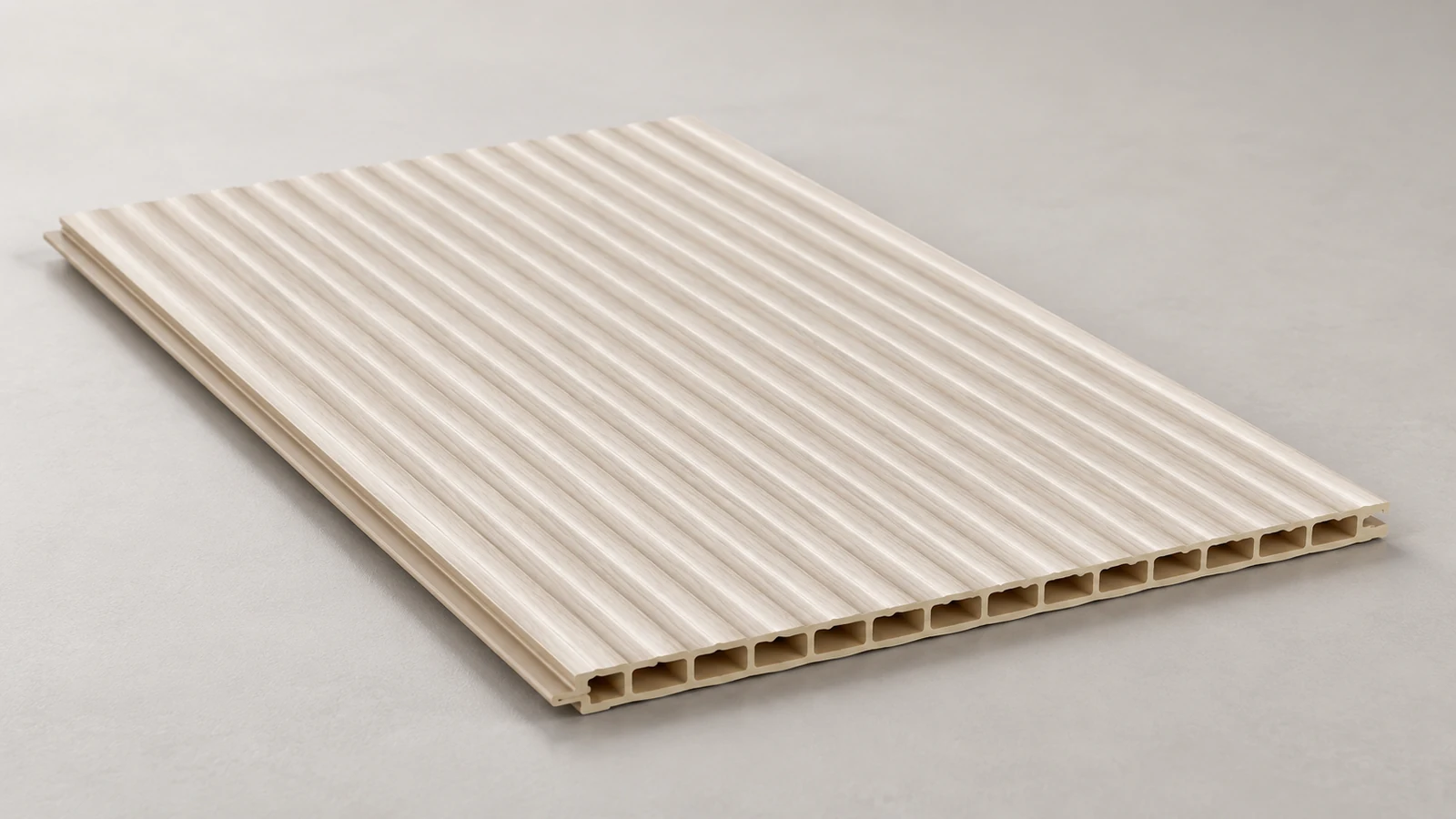
Why WPC Wall Panel Quotes Differ: Coverage, Profiles and Installation Scope

The WPC wall panel price cannot be compared accurately by piece price alone. Two quotations may use different panel widths, effective coverage, profile depth, surface finish, packing, trims and cutting assumptions while both describe the product as a WPC wall panel. For project buyers, the better comparison is to normalize the wall area, panel coverage, accessory scope and packing basis first. Dongfanglong supplies wall panels, WPC grating/fluted panels and matching installation profiles, so the quotation should be reviewed as a wall system rather than as a loose panel price.
Why Price per Piece Can Be Misleading
A search for what is the price of WPC wall panel often assumes that one panel can be compared directly with another. That only works when both pieces cover the same wall area and include the same product structure and finish.
A wider panel may cost more per piece but require fewer pieces across the wall. A narrower panel may have a lower piece price but create more joints and more cutting. The buyer therefore needs the effective face width and length before deciding whether a WPC wall panel price per piece is actually lower on a project basis.
Price boundary: Dongfanglong’s client data does not provide one universal public selling price. This article explains the variables that make quotations differ; it does not invent a price range, MOQ, freight rate or discount.
Compare Effective Coverage Before Comparing WPC Wall Panel Price per Square Meter
For WPC wall panel price per square meter, effective coverage is one of the most important inputs. Interlocking panel edges may be part of the physical profile but not part of the visible wall coverage.
Dongfanglong’s Type 149 WPC grating panel publishes a 140 mm effective face width, while Type 218 publishes 210 mm. If two panels have the same stock length but different effective widths, the wider profile covers more wall per piece.
The quantity takeoff should therefore begin with:
net wall area or width ÷ effective panel coverage = base quantity
Then adjust for openings, corners, direction, cuts and waste. Only after that is it meaningful to compare total material cost.
Convert Every Quote to the Same Wall-Coverage Basis
The most reliable way to compare quotations is to convert every offer to the same project coverage before comparing money. A simple comparison structure is:
Effective area per panel = effective face width × usable panel length
Base panel quantity = net wall area ÷ effective area per panel
Project material quantity = base panel quantity + project-specific cutting/offcut allowance
The calculation should use one consistent unit system. If effective width is in millimetres and length is in metres, convert them before calculating square metres. If the project has several wall heights or separate finish zones, calculate them separately rather than averaging unlike elevations.
This method makes a WPC wall panel price per sqm comparison more meaningful because the denominator is the wall coverage actually delivered by the quoted profile, not the nominal size printed in a product name.
The waste/offcut allowance should come from the elevation. A wall with full-height uninterrupted panels may use stock efficiently, while a wall with many openings and centered visual layouts can generate substantially more offcut. The article deliberately does not assign one standard waste percentage because the client data does not support a universal value.
WPC Wall Panel Price per Meter Depends on the Profile Being Quoted
A WPC wall panel price per meter can also be misleading if the profiles have different widths, weights or structures. One linear metre of a 140 mm effective-width panel and one linear metre of a 210 mm effective-width panel do not cover the same area.
Dongfanglong’s product records show this clearly. Type 149 is published at 850 g/m, Type 169 at 1,000 g/m, and Type 218 at 1,350 g/m. These values describe different verified profiles. They do not create a simple rule that a heavier panel must always cost more; they show why quotations should identify the exact model and cross-section.
For procurement, “price per metre” should always be tied to the named profile, effective width and finish.
Profile Depth and Structure Change the Quotation Basis
Dongfanglong’s WPC wall-panel and grating range includes multiple cross-sections and thicknesses. Type 149 is published at 14 mm, Type 148 at 15 mm, and Type 169 at 18 mm. Other wall decorative panels use different integrated, hollow or moulded structures.
These construction differences can affect material use, weight, rigidity, visible depth and packaging. The buyer should therefore normalize the profile before comparing a WPC wall panel quotation.
Do not compare a deep fluted panel, a flat integrated decorative panel and a moulded wall panel as if they are the same commodity simply because all three sit in the WPC/decorative wall family.
Finish Choice Can Change the Quoted Product
Surface finish is another quote variable. Dongfanglong product descriptions reference wood-grain, solid-color and other laminated decorative finishes across its catalog. If two suppliers quote different surface systems, the visible product and the quotation scope are no longer directly comparable.
Before asking for a WPC wall panel wholesale price, state the selected finish or approved sample reference. If custom color or surface matching is required, that requirement should be written separately rather than assumed from a catalog image.
For large commercial projects, batch consistency also matters. The buyer should confirm whether the same finish reference applies to all panels and matching trims included in the order.
Separate Material Package Cost From Installed Wall Cost
The phrase WPC wall panel installation cost is often used as if it were the same as the material quotation. It is not. A wall-panel supplier may quote only panels and trims, while the installed project cost can include site preparation and labor that sit outside the product supply scope.
A useful commercial split is:
Material Package
- wall panels;
- inner and outer corner profiles;
- skirting, moulding or termination profiles;
- packing;
- order-specific accessories explicitly included by the supplier.
Installation-Related Scope
- substrate preparation;
- site measurement and setting-out;
- fixing method, adhesive or fasteners where applicable;
- cutting and fitting around openings;
- installation labor;
- site access, protection and cleanup.
Dongfanglong’s product data supports the panel and matching-profile side of this split, but it does not provide one universal installed labor rate or site-installation price. Therefore, a material quotation should not be described as a fully installed wall cost unless the contract explicitly includes that work.
Matching Trims Are Part of the Wall-Material Cost
A finished WPC wall system may require inner corners, outer corners, skirting, moulding, cornice or termination profiles. Dongfanglong’s catalog includes a dedicated Wall Installation Fittings category, which means buyers can source panel and related profiles within one product system.
This creates an important distinction:
panel price ≠ installed wall-material scope.
If Supplier A includes only wall panels and Supplier B includes corner trims, skirting and finishing profiles, the total quotations should not be compared without separating those items.
Cutting Waste Changes the Real WPC Wall Panel Cost per Sqm
The WPC wall panel cost per sqm also depends on how the stock length fits the elevation. Dongfanglong’s verified grating panels commonly publish a standard 3,000 mm length. A wall that uses that length efficiently will create a different waste pattern from a wall with many short segments, doors or windows.
Waste is influenced by:
- wall height and width;
- panel direction;
- door and window openings;
- corner returns;
- centered feature-wall layout;
- finish direction or pattern continuity;
- whether offcuts can be reused elsewhere.
The correct allowance should come from the project takeoff, not from one universal waste percentage.
Packaging Can Change the Logistics Cost Even When Panel Price Is Similar
Dongfanglong’s product pages publish packing data for many profiles. Type 149, for example, is listed at 10 pieces per box with an outer packaging size of 301 × 20 × 15 cm. Type 218 is also listed at 10 pieces per box, but its outer packaging size is 301 × 123 × 16 cm.
Those cartons do not occupy the same transport volume. Therefore, a quotation comparison for imported wall panels should include:
- pieces per carton;
- carton dimensions;
- weight basis where available;
- total carton count;
- packing method;
- freight term or delivery scope.
This does not mean packaging alone determines the purchase decision. It means an apparently similar ex-works panel price can lead to a different landed-material cost.
Why WPC Wall Panel Price per Sheet Is Not Always the Right Metric
The long-tail search WPC wall panel price per sheet is common, but many decorative profiles are sold as long interlocking panels rather than flat sheet goods. In that case, “per sheet” can hide the profile width and effective coverage that actually determine the wall quantity.
Buyers should use the commercial unit that matches the product format:
- per piece for the exact named profile;
- per linear metre when width is also stated;
- per square metre based on effective coverage;
- per carton for logistics planning;
- total project quantity for procurement approval.
The metric is only useful when the underlying profile is controlled.
Normalize the Quote Before Deciding Which WPC Wall Panel Is Cheaper
| Quote Variable | Supplier A | Supplier B | Buyer Should Normalize |
|---|---|---|---|
| Panel model/profile | — | — | Same profile or clearly different alternative? |
| Effective width | — | — | Compare actual wall coverage. |
| Standard length | — | — | Use the same takeoff basis. |
| Profile depth/structure | — | — | Do not compare unlike cross-sections as the same item. |
| Surface finish | — | — | Use the same approved finish reference. |
| Pieces per carton | — | — | Compare packing and total cartons. |
| Corner/edge trims | Included? | Included? | Normalize accessory scope. |
| Skirting/moulding | Included? | Included? | Normalize wall-system scope. |
| Waste allowance | — | — | Use the same elevation and cutting logic. |
| Freight/delivery | Included? | Included? | Compare the same commercial term. |
Build a Quotation Evidence Chain Before Approving the Order
A comparable price is stronger when every commercial line can be traced back to a technical reference. Before approving a WPC wall-panel order, the buyer can build a simple evidence chain:
Quotation → product code/profile drawing → effective coverage → approved finish sample → trim list → packing specification → project takeoff
Each item answers a different question:
| Document / Evidence | What the Buyer Should Verify |
|---|---|
| Quotation | Exact product code, unit basis, quantity, finish and included accessories. |
| Cross-section drawing | Overall width, effective width, thickness/profile depth and joint/interlock. |
| Approved sample | Color, wood grain, surface texture and visible joint appearance. |
| Trim schedule | Inner corner, outer corner, skirting, moulding and termination items included or excluded. |
| Packing specification | Pieces per carton, carton dimensions and weight basis where available. |
| Elevation / takeoff | Wall dimensions, openings, direction, cut logic and final project quantity. |
This evidence chain helps prevent a common purchasing problem: a low price is approved before anyone notices that the quoted profile, finish or trim scope differs from the project assumption.
When the Price-Comparison Method in This Article Is Not Enough
This comparison method is designed for WPC decorative wall-panel procurement where the project can be measured by effective panel coverage and a defined accessory scope. A different commercial or engineering review is needed when the quotation includes major site labor, substrate systems, structural backing, custom fabrication, special code-compliance requirements, unusual curved surfaces or other work outside the verified Dongfanglong product scope.
Freight should also be compared only when the same commercial term and destination are used. A supplier’s ex-works price and another supplier’s delivered price are not comparable until transport scope is normalized.
In short, the method helps normalize panel-material quotations; it should not be stretched into a universal installed-construction cost model.
What Should a WPC Wall Panel RFQ Include?
A quote becomes much more useful when the buyer sends the same data to every supplier. Include:
- wall elevation and net area;
- selected panel/profile or required appearance;
- effective coverage requirement;
- stock or cut length;
- surface finish reference;
- required corners, trims, skirting and moulding;
- door/window openings that affect cutting;
- installation direction;
- quantity takeoff or request for supplier takeoff;
- packing and delivery requirements.
Dongfanglong’s Wall Decorative Panels, Wood Plastic Composite Grating Panels and Wall Installation Fittings categories provide the product framework needed to compare a complete wall-material package.
The Best Price Comparison Uses the Same Wall, Not the Same Product Name
The practical answer to “what is the price of WPC wall panel?” is that the quote depends on what wall the buyer is actually trying to build. The same product name can hide different coverage, cross-sections, finishes and accessories.
For Dongfanglong’s B2B buyers, the stronger purchasing method is to normalize the elevation, effective coverage, fittings, waste and packing first, then compare total quotations on the same scope. Project drawings and quote requirements can be submitted through the Dongfanglong contact page.